GEOTECHNICAL ENGINEERING
MADISON
HomeLaboratoryLaboratory CBR test

Laboratory CBR Testing for Pavement Design in Madison

Knowledgeable. Thorough. Resourceful.

LEARN MORE

Madison’s growth from a capitol city on an isthmus to a thriving regional hub has always been shaped by the land—and the land here demands respect. The glacial history of the Four Lakes region left behind a patchwork of silty clays, outwash sands, and organic deposits that make every construction project a conversation with the subsurface. When a new subdivision goes in on the west side or a commercial lot is redeveloped near the Beltline, the subgrade isn't just dirt—it's the loaded spring that will either support your pavement or fail it. Before you spec asphalt or concrete, you need the California Bearing Ratio nailed down in a controlled environment. Our lab handles the soaking, swelling, and penetration phases of the laboratory CBR test so you know exactly what your soil can take after a Wisconsin winter. We often pair this with grain-size analysis to understand the fines content driving frost susceptibility.

A soaked CBR value below 3 in Madison’s silty subgrades means you’re not just thickening pavement—you’re redesigning the section, period.
Our service areas

Our approach and scope

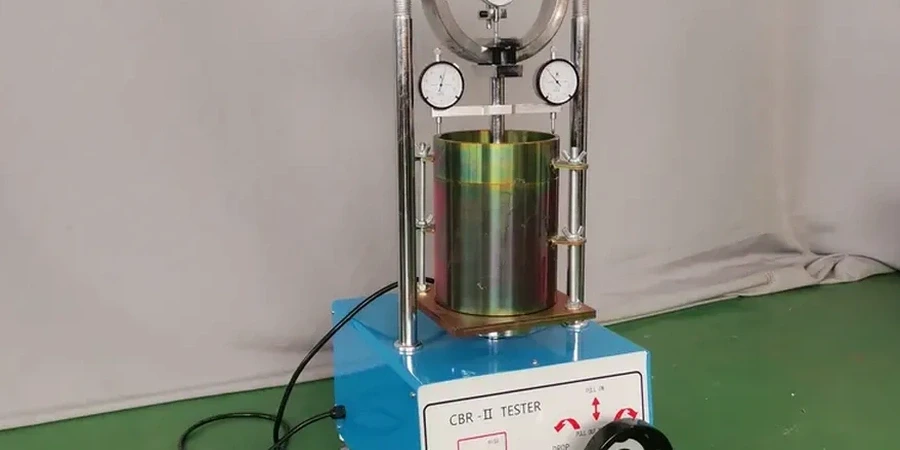
The weathered glacial till common across Dane County rarely behaves the same way twice. One trench might hit dense clay with a CBR above 15; another fifty feet away could bottom out on a silt seam that loses 70% of its strength when saturated. A laboratory CBR test strips away field uncertainty by applying ASTM D1883 procedures to a carefully remolded or undisturbed specimen. We bring the sample to optimum moisture using modified Proctor compaction—typically ASTM D1557 for Madison-area commercial work—then soak it for 96 hours to simulate the worst-case spring thaw. The penetration piston advances at 0.05 inches per minute while our data acquisition system logs load versus deformation. The resulting stress-penetration curve gets corrected for surface irregularities, and we report the CBR at 0.1-inch and 0.2-inch penetration against the standard crushed limestone reference. If the 0.2-inch value governs, we flag it. For granular subbase materials, the unsoaked CBR protocol is often more representative, and we run it alongside soaked values to bracket the design range. The report includes the swell percentage, moisture content before and after soaking, and dry density—everything the WisDOT pavement design manual needs to feed into your structural number calculation.
Laboratory CBR Testing for Pavement Design in Madison
Technical reference — Madison

Local geotechnical context

Around here, the biggest gamble isn't the test itself—it's field sampling done without a geotech present. We've seen contractors grab a five-gallon bucket of topsoil from a silted-up swale and call it a representative subgrade sample. That bucket gives you a CBR of maybe 2, and suddenly your pavement section needs eight inches of aggregate and a stabilization layer nobody budgeted for. A laboratory CBR test is only as good as the sample you feed it. We require samples sealed immediately in plastic-lined bags, labeled with station and depth, and delivered within 48 hours if they're undisturbed Shelby tubes. Remolded samples need enough material for a full Proctor curve—typically 45 pounds per soil type. If the sample dries out or gets contaminated with organic debris, the lab results will trend low and you'll overdesign your pavement. The Wisconsin DOT spec for subgrade preparation (Section 207) assumes a consistent CBR input; garbage in means overruns out. Another risk: skipping the swell test. In Madison's wet springs, a subgrade with 4% swell potential can lift a lightly-loaded parking lot enough to crack it. That swell number comes directly from the CBR soak phase, and ignoring it is a mistake we've seen cost re-pave jobs within two years.

Need a geotechnical assessment?

Reply within 24h.

Email: contact@geotechnicalengineering1.org

Reference standards

ASTM D1883 – Standard Test Method for California Bearing Ratio (CBR) of Laboratory-Compacted Soils, AASHTO T193 – Standard Method of Test for the California Bearing Ratio, ASTM D1557 – Modified Proctor Compaction (56,000 ft-lbf/ft³), WisDOT Standard Specifications, Section 207 – Subgrade Preparation, ASTM D2487 – Unified Soil Classification System (USCS)

Reference parameters

ParameterTypical value
StandardASTM D1883 / AASHTO T193
Sample typeRemolded or undisturbed Shelby tube
Compactive effortModified Proctor (ASTM D1557), 56,000 ft-lbf/ft³
Soaking period96 hours submerged (soaked CBR)
Penetration rate0.05 in/min (1.27 mm/min)
Surcharge weight10 lb minimum, per ASTM D1883
Reported valuesCBR at 0.1″ and 0.2″, swell %, dry density
Typical Madison subgrade CBR3–10 for silty clay; 15–40 for granular fill

Frequently asked questions

What's the difference between field CBR and laboratory CBR, and when do I need the lab version?

Field CBR gives you an in-situ measurement right at the surface of a compacted layer—great for quality control. A laboratory CBR test is what you need during design, before construction starts. It lets us control moisture and density in a way the field can't, and crucially, it includes the 96-hour soaking phase. That soak simulates the saturated subgrade condition Madison sees every March, which is almost always the governing case for pavement thickness. If you skip the lab test and rely solely on field CBR taken in August, you'll underdesign your section.

How much soil do I need to send for a laboratory CBR test?

For a single remolded CBR test (three compaction points), we need about 45 to 50 pounds of material. That allows us to run the full moisture-density relationship, compact the specimens, and have enough left over for classification testing. If you want both a soaked and unsoaked CBR on the same soil, double that quantity. For undisturbed samples, a 3-inch diameter Shelby tube with a minimum 6-inch length is standard. Plastic bags and sealed buckets are mandatory—we've had to reject samples that arrived in cardboard boxes half-dried.

What does a laboratory CBR test cost in Madison?

A single-point laboratory CBR test on a remolded sample typically runs between US$130 and US$220, depending on whether we're doing the full Proctor compaction curve in-house or working with a provided maximum dry density. Soaked CBR takes longer and costs toward the upper end of that range. A three-point CBR series with full index testing is more, and we always provide a written quote before starting. Volume pricing applies for projects with more than five test points.

How long does it take to get results?

A standard soaked laboratory CBR test takes about seven working days from sample receipt to report. Four days of that is the soaking period, which cannot be rushed—it's what the ASTM standard requires. Unsoaked CBR can be turned around in three to four days. If your project is on a tight deadline, let us know up front. We can often prioritize sample compaction and have the unsoaked values to you early, then follow up with the soaked results when the soaking period ends.

Location and service area

We serve projects in Madison and surrounding areas.

View larger map