GEOTECHNICAL ENGINEERING
MADISON
HomeInvestigationCPT (Cone Penetration Test)

CPT (Cone Penetration Test) in Madison: Accurate Subsurface Data Without the Guesswork

Knowledgeable. Thorough. Resourceful.

LEARN MORE

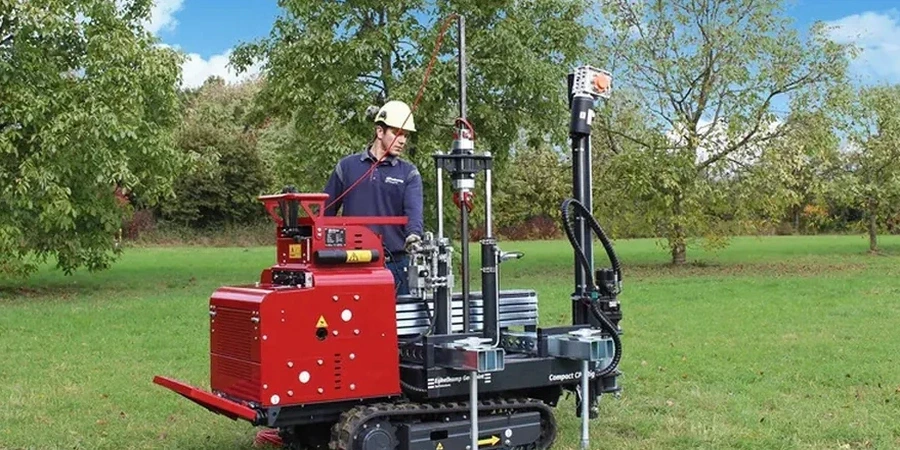
Too many geotechnical reports in Madison rely on sparse SPT data that misses thin, weak layers hiding in the glacial deposits. We’ve seen it before—a project on the near-west side hits a pocket of soft silt at 18 feet that standard borings skipped entirely. The CPT (Cone Penetration Test) eliminates that blind spot. Our truck-mounted rig pushes a cone through the soil at a steady 2 cm/s, recording tip resistance, sleeve friction, and pore pressure every centimeter. You get a continuous profile, not just a few split-spoon readings. For jobs around the isthmus where fill overlies ancient Lake Yahara sediments, this resolution matters. We typically pair CPT with targeted SPT drilling when we need samples for lab classification, creating a dataset that satisfies both IBC Chapter 18 and the local building department’s review without over-mobilizing equipment.

A single CPT sounding replaces half a dozen SPT borings for stratigraphic detail—while logging pore pressure data that standard drilling can’t capture.
Our service areas

Our approach and scope

Out on the glacial terrain that defines Dane County, we regularly encounter interbedded clays and silts where the pore pressure data from a CPT tells you more than any blow count. The u2 filter element picks up excess pore pressures that flag drainage problems before you pour a foundation. We run seismic CPT modules when shear wave velocity profiles are required, which happens a lot for liquefaction assessments on the sandy outwash near the Yahara River. Every sounding is referenced to NAD 83 and NAVD 88, with coordinates tied to the Wisconsin County Coordinate System. The cone is calibrated before and after each job against ASTM D5778 load cells—zero drift on the friction sleeve can ruin a dissipation test, and we check it religiously. For contaminated sites, we’ve run the membrane-less cone to avoid fluid loss in hydrocarbon plumes, a trick that’s saved several brownfield redevelopments downtown from costly delays. Data reduction flows through the standard soil behavior type charts, but we always ground-truth with local experience because Madison’s lacustrine clays plot differently than marine clays from the coasts. When a project also needs bearing capacity verification under a heavy column load, the CPT data feeds directly into plate load test correlations for modulus of subgrade reaction.
CPT (Cone Penetration Test) in Madison: Accurate Subsurface Data Without the Guesswork
Technical reference — Madison

Local geotechnical context

Madison sits on a complex sequence of glacial tills, outwash sands, and lacustrine silts deposited during the last retreat of the Wisconsin Glacier roughly 12,000 years ago. The Yahara chain of lakes—Mendota, Monona, Wingra—left behind thick deposits of compressible organic silts in the low-lying areas where much of the city’s infrastructure sits. A standard boring log can miss a 6-inch layer of sensitive clay that loses half its strength when remolded. CPT catches it. The cone’s friction ratio and pore pressure response flag these structured clays immediately. We’ve worked on sites within the liquefaction susceptibility zones mapped by the Wisconsin Geological and Natural History Survey, where sandy lenses below the water table at 8 to 12 feet require careful assessment under the seismic provisions of ASCE 7-22. Skipping CPT on these sites means relying on correlations that were never calibrated for Midwestern glacial stratigraphy—a gamble that shows up later as differential settlement or worse during a design-level earthquake.

Need a geotechnical assessment?

Reply within 24h.

Email: contact@geotechnicalengineering1.org

Reference standards

ASTM D5778-20 (Standard Test Method for Electronic Friction Cone and Piezocone Penetration Testing of Soils), ASCE 7-22 (Minimum Design Loads for Buildings and Other Structures), IBC 2024 (International Building Code, Ch. 18 Soils and Foundations), ASTM D2487-17 (Standard Practice for Classification of Soils for Engineering Purposes)

Reference parameters

ParameterTypical value
Cone penetration rate20 mm/s ± 5 mm/s
Tip resistance (qc) range0.1 to 100 MPa
Sleeve friction (fs) range0.5 kPa to 1 MPa
Pore pressure (u2) range0 to 3.5 MPa
Maximum push depth (Madison rig)65 ft (20 m) in typical glacial soils
Cone base area10 cm² (standard)
Data sampling interval1 cm (continuous)
Dissipation test durationUntil u2 returns to hydrostatic baseline

Frequently asked questions

What does a CPT test cost in the Madison area?

For most projects in Dane County, you’re looking at US$190 to US$210 per sounding meter, with a typical minimum mobilization covering the first 30 feet. Deeper pushes past 50 feet add a modest surcharge because we swap to heavier push rods. The final number depends on access—tight lots on the isthmus sometimes require smaller equipment and a second crew member for traffic control, which bumps the hourly rate slightly. We quote firm prices after a site visit, never from a desk.

How does CPT compare to SPT for Madison’s glacial soils?

CPT gives you a continuous log with three independent measurements—tip resistance, sleeve friction, and pore pressure—every centimeter. SPT gives you a blow count every 2.5 or 5 feet and a disturbed sample. In Madison’s interbedded tills and silts, the continuous profile catches thin layers that SPT skips entirely. We still run SPT on most jobs because you need samples for lab testing, but the CPT data fills the gaps. For liquefaction studies on outwash sands, CPT is generally preferred because it’s repeatable and directly measures the soil’s response under load.

How deep can you push a CPT cone in the Madison area?

Our standard rig reaches 65 feet in typical glacial soils around Madison. Refusal usually happens when we hit dense till with cobbles or the top of the sandstone bedrock, which sits at variable depths across Dane County—shallow on the west side near the driftless area, deeper in the pre-glacial bedrock valleys under the lakes. If we hit refusal early, we switch to rotary wash borings to continue the investigation below that depth.

Location and service area

We serve projects in Madison and surrounding areas.

View larger map