GEOTECHNICAL ENGINEERING
MADISON
HomeGeophysicsSeismic tomography (refraction/reflection)

Seismic Tomography for Madison’s Glacial Subsurface: Refraction & Reflection

Knowledgeable. Thorough. Resourceful.

LEARN MORE

The subsurface contrast between Madison’s Isthmus and the West Side is stark. Downtown, near the Capitol, you hit weathered sandstone and dolomite within 20 feet. Move west toward Middleton and the glacial drift thickens to over 100 feet of interbedded silt, sand, and till, often masking irregular bedrock topography. Seismic tomography bridges this uncertainty. Our team runs P-wave refraction and SH-wave reflection surveys to delineate the contact between unconsolidated Quaternary deposits and the Paleozoic bedrock beneath the Yahara River valley. When drill spacing is limited, a MASW survey combined with refraction profiles gives us both a velocity model and VS30 for seismic site class per IBC Chapter 16, which is critical in a city where the drift–bedrock interface can shift 40 feet across a single city block.

We routinely map the 1,200 m/s contour as the top of competent rock across Madison’s glacial terrain, resolving velocity contrasts that boreholes alone miss.
Our service areas

Our approach and scope

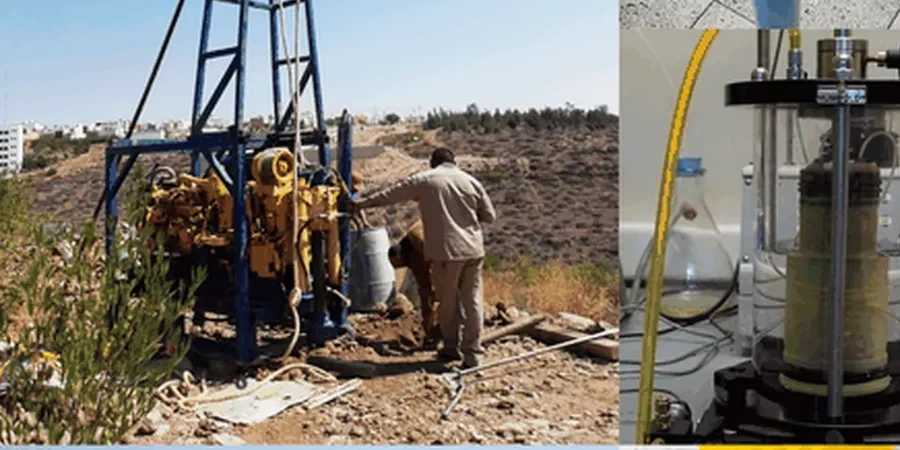
On the University of Wisconsin campus, we often see projects where borehole refusal is misinterpreted as true bedrock. The Mount Simon Sandstone varies in cementation, and a weathered top layer can fool a driller into stopping early. Our seismic reflection processing applies normal moveout correction and CMP stacking to resolve these ambiguities down to 300 feet. We deploy 48-channel Geode seismographs with 4.5 Hz geophones, spaced at 5-foot intervals for high-frequency urban surveys. Shot points use a 16-pound sledge on a metal plate for shallow targets, switching to a Betsy Seisgun for deeper penetration in the Yahara till. Tomographic inversion runs through Rayfract software, producing 2D velocity cross-sections where you can trace the 1,200 m/s contour as the probable top of rock. Data acquisition follows ASTM D5777 for refraction and D7128 for reflection, with each line calibrated against at least one existing boring to anchor the velocity–lithology relationship. The final deliverables include travel-time curves, interpreted geologic sections, and Poisson’s ratio maps when combined with surface wave data.
Seismic Tomography for Madison’s Glacial Subsurface: Refraction & Reflection
Technical reference — Madison

Local geotechnical context

A recurring mistake we see on Madison’s east side involves assuming uniform bedrock depth from sparse borings and skipping seismic lines. The Horicon Member of the Holy Hill Formation is a maze of buried valleys filled with compressible silt and organic lenses. One project off East Washington Avenue encountered a 30-foot-deep paleochannel between two borings spaced 80 feet apart. The contractor had already ordered short H-piles and faced a six-week delay. Seismic tomography would have caught the low-velocity anomaly before excavation started. Another risk is misidentifying a high-velocity boulder layer within the till as bedrock. On a School of Veterinary Medicine expansion, our reflection profile correctly placed the true bedrock 15 feet below the boulder train, saving the design team from undercutting a phantom refusal surface. Without a continuous velocity model, differential settlement across the site becomes a real structural liability.

Need a geotechnical assessment?

Reply within 24h.

Email: contact@geotechnicalengineering1.org

Reference standards

ASTM D5777 – Standard Guide for Using the Seismic Refraction Method, ASTM D7128 – Standard Guide for Using the Seismic Reflection Method, IBC Chapter 16 (ASCE 7-22) – Site Classification based on VS30, ASTM D7400 – Standard Test Methods for Downhole Seismic Testing, FHWA HI-11-031 – Geotechnical Engineering Circular No. 5 (Geophysics)

Reference parameters

ParameterTypical value
Survey depth range (refraction)5 to 120 ft below grade
Survey depth range (reflection)30 to 300 ft below grade
Typical geophone spread48 channels, 5 ft spacing
Energy source (shallow)16 lb sledgehammer on plate
Energy source (deep)Betsy Seisgun (12-gauge)
Minimum detectable velocity contrast> 200 m/s between layers
SeismographGeode 24-bit, 48-channel
Geophone frequency4.5 Hz vertical component

Frequently asked questions

What depth can seismic refraction reach in Madison’s glacial soils?

With a 230-foot spread and a Betsy Seisgun source, we reliably image to 100–120 feet in the Yahara till. Penetration drops in dry, loose sand where attenuation is high. For deeper targets exceeding 200 feet, we recommend a reflection survey using a weight drop or accelerated hammer on a metal baseplate.

How much does a seismic tomography survey cost in Madison?

A typical single-line refraction survey with 48 channels and a 230-foot spread runs between US$2,360 and US$3,800, depending on site access and surface conditions. A multi-line reflection project with full processing and interpretation ranges from US$4,200 to US$5,850. All quotes include mobilization within Dane County, data acquisition, tomographic inversion, and a signed engineering report.

Can you work on paved surfaces downtown?

Yes. We use epoxy-mounted geophones on concrete or asphalt, with a 2-inch-thick aluminum strike plate for the sledgehammer source. This avoids core drilling through pavement. We also schedule surveys on Sunday mornings for low-traffic windows near the Capitol Square.

How do you distinguish a boulder bed from true bedrock?

Boulders within till produce isolated velocity highs but lack a continuous refractor. In the velocity tomogram, bedrock appears as a persistent 1,200–1,500 m/s layer across the entire spread, while a boulder train shows up as discrete high-velocity lenses floating above a lower-velocity matrix. We verify with a short reflection line if ambiguity persists in the refraction model.

What’s the typical turnaround time for results?

Field acquisition takes one day per 1,200 linear feet. Preliminary velocity models are ready in 48 hours via digital delivery. The final report, including interpreted geologic cross-sections, Poisson’s ratio maps, and VS30 calculations, ships within five business days after field completion.

Location and service area

We serve projects in Madison and surrounding areas.

View larger map